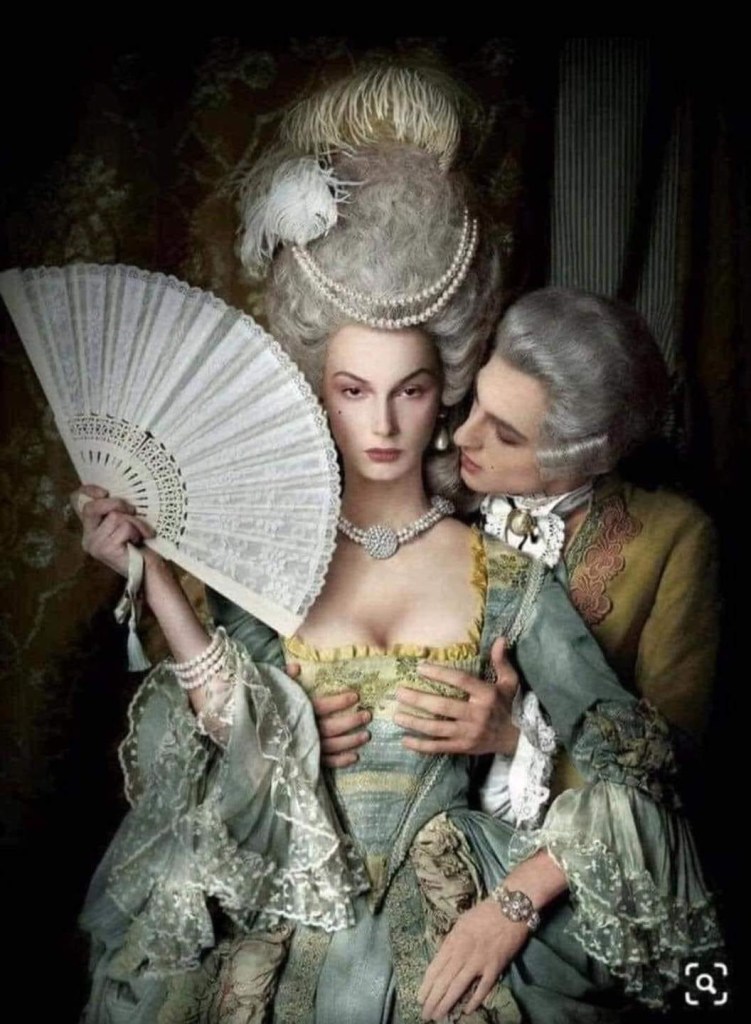
How thankful are you for showers, perfume and toilet paper now?!
IN THE YEARS 1600 AND 1700
It is said that when visiting the Palace of Versailles in Paris, you notice that the sumptuous palace has no bathrooms.
In the Middle Ages, there were no toothbrushes, perfumes, deodorants, and much less toilet paper.
Human excrements were thrown out of the palace windows.
On a holiday, the palace kitchen was able to prepare a feast for 1500 people, without the minimal hygiene.
In today’s movies we see people of that era shaking or flapping..
The explanation is not in the heat, but in the bad smell they emitted under the skirts (which were deliberately made to contain the smell of intimate parts, as there was no hygiene).
It was also not customary to shower because of the cold and the almost no running water.
Only the nobles had lackeys to flaunt them, to dispel the bad smell that exhaled the body and mouth, as well as to repel the insects.
Those who have been to Versailles have admired the huge and beautiful gardens that, at that time, were not only contemplated, but used as a portrait in the famous ballads promoted by the monarchy, because there were no bathrooms.
In the Middle Ages, most weddings took place in June (for them, the beginning of summer). The reason is simple: the first bath of the year was taken in May; so in June, the smell of people was still tolerable.
However, as some smells were already beginning to be annoying, brides carried bouquets near their bodies to cover up the stench.
Hence the explanation of the origin of the bridal bouquet.
Baths were taken in a single huge tub filled with hot water. The head of the family had the privilege of the first bath in clean water.
Then, without changing the water, came the others in the house, in order of age, women, also by age and, finally, children.
Babies were the last ones to bathe. When it came her turn, the water in the bathtub was so dirty that it could kill a baby inside.
The roofs of the houses had no sky and the wooden beams holding them up were the best place for animals: dogs, cats, rats and cockroaches to stay warm. When it rained, the leaks forced the animals to jump on the ground.
Those who had money had tin plates. Certain types of food oxidized the material, causing many people to die from poisoning.
Let’s remember that hygiene habits of the time were terrible.
Tomatoes, being acidic, were considered poisonous for a long time, can cups were used to drink beer or whiskey; this combination, sometimes, left the individual “on the floor” (in a kind of narcolepsy induced by mixing alcoholic beverage with tin oxide). Someone passing by the street would think he was dead, so they picked up the body and prepared for the funeral. Then the body would be placed on the kitchen table for a few days and the family stayed watching, eating, drinking and waiting to see if the dead woke up or not. Hence the dead are candleed (candle or wake), which is the vigil next to the coffin.
England is a small country where there wasn’t always room to bury all the dead.
Then the coffins were opened, the bones were extracted, placed in ods and the grave was used for another corpse. Sometimes, when opening the coffins, there were scratches on the interior, indicating that the dead man had, in fact, been buried alive.
So, when closing the coffin, the idea came to tie a strap from the deceased’s wrist, go through a hole made in the coffin and tie it to a bell. After the burial, someone was on duty next to the grave for a few days. If the individual woke up, the movement of his arm would ring the bell.
And would be “saved by the bell
which is a popular expression used by
us to this day.
 Kookie